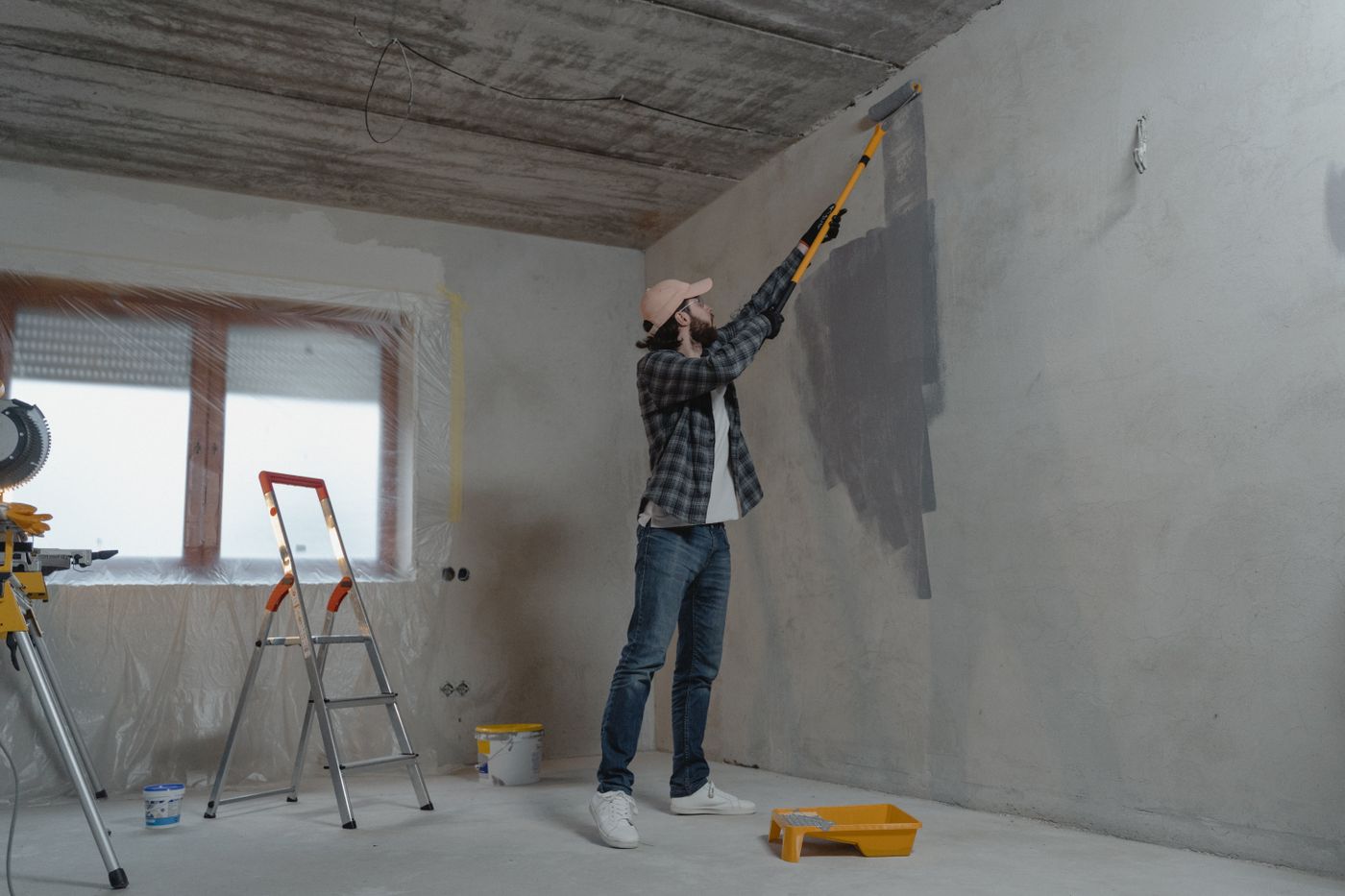
A room-painting budget needs more than a gallon count.
Use the wall calculation first, then add the supplies and preparation your room actually needs.
Illustrative photograph. Budget figures below are worked examples, not expenses from the pictured scene.
Work from paintable area
A 12-by-12-foot room with 8-foot walls has 384 square feet of gross wall area. Using this calculator’s example deductions of 20 square feet for a door and 15 for a window leaves 349 square feet. Two coats cover 698 square feet of application area. The ceiling adds another 144 square feet per coat if included.
At an illustrative coverage of 350 square feet per gallon per coat, 698 ÷ 350 = 1.994 gallons. That rounds to two one-gallon cans before an extra allowance. Adding 10% brings the estimate to 2.194 gallons, so buying only whole gallons means three cans. The allowance is a planning choice, not a product guarantee.
Why a small allowance changes the purchase
Rounding happens at the package level. A calculation just below two gallons can cross into a third can with a small increase in area or a lower coverage assumption. Check which pack sizes your paint comes in and keep the color and finish consistent. Extra paint may be useful for touch-ups, but it is not automatically consumed by the job.
Budget line
What to check
Finish paint
Color, finish, can size, coverage, and coats
Primer
Whether the surface and selected paint system call for it
Preparation
Filler, abrasives, cleaning materials, and repairs
Application
Roller covers, brushes, tray liners, and extension pole
Protection
Drop cloths and masking materials
Other costs
Tax, delivery, and equipment you do not already own
For an example budget, three gallons at a hypothetical $35 cost $105. If your actual supplies quote is $40, the included subtotal is $145 before tax. Primer and repairs remain separate unless you priced them. Neither input is a claim about local shelf prices.
Record each wall's length and height. Keep the ceiling separate if it uses a different paint, and separate trim, doors and feature walls. Combining every surface into one gallon total only works when those surfaces share the same product and finish.
The room calculator uses assumed opening sizes of 20 square feet per door and 15 per window. If your room has a wide sliding door or a bank of windows, a manual surface schedule will be more useful than relying on those defaults. Record what was deducted so someone else can check the estimate.
How coverage changes a 12-by-12 room
For the 349-square-foot wall example, two coats and 10% extra create 767.8 square feet of coverage demand. Different coverage inputs produce the following purchase quantities:
Coverage per gallon
Calculated gallons
Whole gallons
300 sq ft
2.559
3
350 sq ft
2.194
3
400 sq ft
1.920
2
These are alternative assumptions, not a recommendation to buy two gallons. Use the selected paint's instructions and the actual surface. The two-gallon result at 400 square feet has much less spare capacity than a three-gallon order.
Build a purchase list beyond the finish paint
Preparation may require patching material, abrasive sheets, cleaner and caulk. Application may require rollers, covers, brushes, a tray or liners, masking and floor protection. Primer, ceiling paint and trim paint should have their own quantity and price if included in the job.
Mark each item “already owned,” “buy” or “not yet priced.” A reusable tool you already own should not inflate this project's cash budget, but a missing roller price should not silently become zero.
A complete worked shopping subtotal
All prices in this example are hypothetical: three gallons at $35 cost $105; preparation supplies cost $18; rollers and brushes cost $24; masking and protection cost $16. That is $163 before delivery and tax. A $12 delivery fee makes it $175. Enter the actual tax amount from your quote separately because the taxable items and rules depend on location.
If you already own the $24 of application tools, the comparable cash subtotal falls to $151 including delivery. If primer is needed but not priced, neither subtotal is complete. Keep the missing item visible instead of adding a reassuring but unsupported contingency percentage.
Keep the estimate useful after the purchase
Save the paint name, base, color code, sheen, container size and receipt. Record how much unopened paint remains and whether the store allows returns for that product. These notes are more useful for touch-ups than a screenshot showing only a dollar total.